
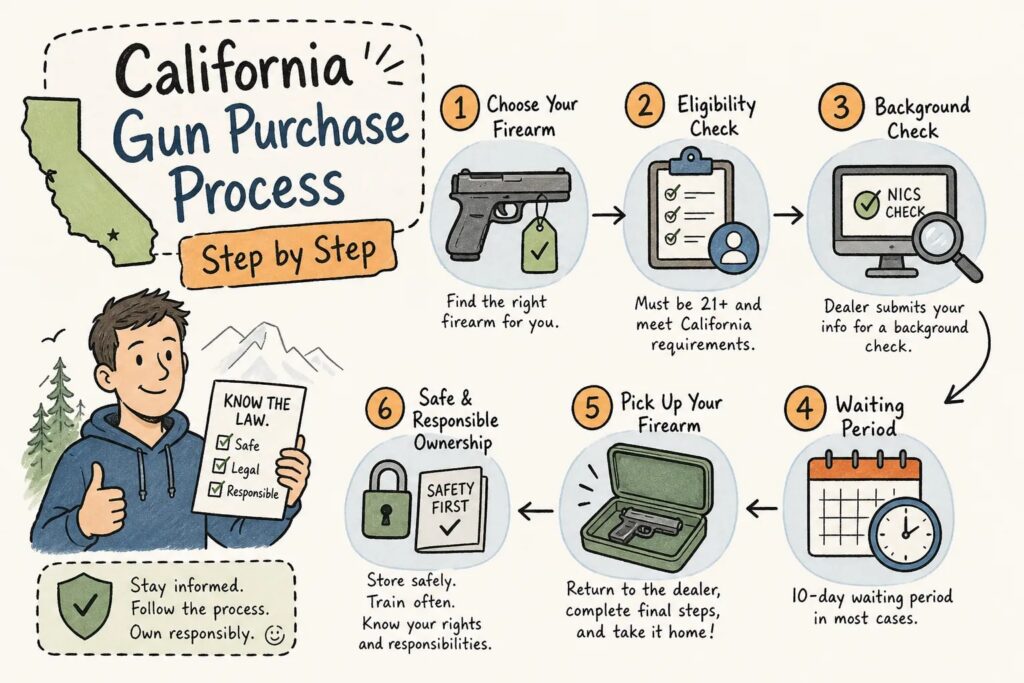
The California gun purchase process follows six core steps: earn your Firearm Safety Certificate, gather your required documents, select a California-compliant firearm, complete the DROS paperwork at a licensed dealer, clear your background check, and pick up your firearm after the mandatory 10-day waiting period. Every legal firearm purchase in California, whether through a dealer sale or a private-party transfer, moves through these same checkpoints. The details vary by transaction type, but the framework stays the same. This guide walks you through each step so you know exactly what to bring, what to expect, and where the process can stall.
California’s purchasing requirements are front-loaded. The prep work happens before you ever choose a firearm, not after you fall in love with one at the counter. Showing up unprepared costs you time and, in some cases, a trip back home to grab the right paperwork. Get organized first, and the california gun purchase process moves smoothly.
Key takeaways
- FSC comes first: You must hold a valid Firearm Safety Certificate before the dealer submits your DROS.
- Two IDs, not one: A valid California driver’s license plus a separate residency document are required for handgun purchases, especially if your ID address is outdated.
- 10 days is non-negotiable: Background-check approval does not allow early pickup. Both the waiting period and DOJ approval must be satisfied before the dealer can release the firearm.
- Private sales must go through an FFL: Hand-to-hand transfers between California residents are generally unlawful. Every private sale requires a licensed dealer to process the DROS.
- Roster rules matter for handguns: Only handguns on the California DOJ Certified for Sale roster may be sold by dealers to the general public. Confirm roster status for the exact model and SKU with your dealer, and check the California DOJ roster yourself before purchase.
What you need before you walk into a California gun store
The Firearm Safety Certificate, or FSC, is the first requirement most buyers need to satisfy. You obtain it by passing a written safety test administered by a California DOJ-certified instructor, typically at a licensed firearms dealer. The test requires a score of at least 75 percent (23 out of 30 questions). The certificate is issued immediately after passing. Certain peace officers, active military, and California CCW holders qualify for exemptions, but most buyers need the FSC.
For identification, you need a valid California driver’s license or DMV identification card. Handgun purchases require a second document proving California residency, such as a recent utility bill, residential lease, property deed, or qualifying government-issued permit, with an address matching your DROS record. If your California ID reads “Federal Limits Apply,” bring supplemental proof of lawful presence or citizenship, such as a valid U.S. passport or certified birth certificate. Dealers may specify which supplemental documents they accept, so confirming in advance saves a wasted trip.
You also need a DOJ-approved firearm safety device at the time of delivery. This means either presenting a device from the California DOJ Roster of Firearm Safety Devices Certified for Sale, purchasing one from the dealer, or providing documentation that you already own a qualifying gun safe. A generic cable lock sold online does not automatically qualify; the specific brand and model must appear on the DOJ roster and be compatible with the firearm you’re purchasing.
Choosing a California-compliant firearm
For handguns, California law restricts dealer sales to the general public to models listed on the California DOJ Handguns Certified for Sale roster. As of late October 2026, that roster contains approximately 1,003 active model entries, and it has been shrinking over time as older certifications lapse. Roster listings are specific to manufacturer, model, caliber, barrel length, and finish, so a visually similar firearm from the same brand may not qualify if the SKU differs. Always ask the dealer to confirm roster status for the exact model and SKU before submitting your DROS.
Rifles and shotguns aren’t subject to the handgun roster, but they carry their own compliance requirements. California’s assault-weapon feature restrictions, fixed-magazine rules for certain configurations, and caliber considerations all affect whether a long gun is legal to sell in this state. As a practical step, confirm roster or configuration compliance with the dealer directly and check the California DOJ roster yourself before purchase. That verification is part of what a knowledgeable California dealer provides.
California gun purchase process: DROS and background check
At the counter, you complete two forms. The federal ATF Form 4473 establishes your eligibility under federal law and is retained by the dealer. The California Dealer’s Record of Sale, or DROS, is submitted electronically by the dealer through DOJ’s DROS Entry System. You sign the printed DROS record; in a private-party transfer, the seller signs it as well. Both documents together create the legal record of the transaction.
How DOJ reviews your DROS submission
California is a point-of-contact state, meaning the dealer submits your information directly to the California DOJ rather than to the FBI. DOJ then checks state records and the federal NICS database to determine eligibility. The result is one of three outcomes: approval, denial, or delay. An approval means the dealer can release the firearm once the waiting period expires. A denial ends the transaction; the dealer cannot override it. A delay means DOJ needs additional time to resolve a record and the firearm stays with the dealer.
DROS fees and dealer charges
Dealers may charge separate transfer or processing fees on top of this amount. Those dealer fees are not standardized, so ask for a written breakdown before submitting your paperwork.
What actually happens during the 10-day waiting period
The 10-day waiting period begins the moment the dealer submits the DROS to DOJ, not when approval comes back. Ten consecutive 24-hour periods must pass before the dealer is permitted to release the firearm. A background-check approval before day 10 does not allow early pickup; both conditions must be satisfied simultaneously: the waiting period has expired and the transfer has been approved. This rule applies equally to handguns and long guns.
A delayed result means DOJ hasn’t resolved your eligibility yet. The firearm stays with the dealer. If DOJ has not reached a final disposition within 30 days of DROS submission, the dealer may release the firearm at their discretion unless another legal issue prevents it. In some cases, DOJ can extend its review window up to 30 additional days. Do not contact the dealer repeatedly during this period or pressure them to release the firearm early; they have no authority to override DOJ’s process.
Buyers must take possession within 30 days of DROS submission. Miss that window and the dealer must cancel the DROS. A new DROS is required along with new state fees and a fresh 10-day waiting period. Mark the pickup deadline on your calendar the day you file the paperwork.
California gun purchase process: private-party transfers
Direct hand-to-hand delivery between two California residents is generally unlawful. Every private-party transfer must go through a California-licensed FFL dealer. The FFL receives the firearm from the seller, holds it throughout the process, runs the DROS on the buyer, enforces the waiting period, and releases the firearm only after all conditions are met. The dealer is a legal requirement and a compliance checkpoint, not a formality.
Both parties appear in person at the dealer with the firearm. The buyer brings a California ID, a valid FSC (or exemption documentation), residency proof for a handgun purchase, and a DOJ-approved safety device. The seller brings a government-issued photo ID; check with the dealer in advance for any additional documentation requirements. Both buyer and seller sign the DROS printout; the dealer signs as witness. If either party’s California ID reads “Federal Limits Apply,” supplemental documentation is required at this stage as well.
| Factor | Standard dealer sale | Private-party transfer |
|---|---|---|
| Who signs the DROS | Buyer only | Buyer and seller; dealer as witness |
| 10-day waiting period | Yes | Yes |
| FSC required | Yes (unless exempt) | Yes (unless exempt) |
| Both parties appear in person | Buyer only | Yes, both buyer and seller |
Confirm the full cost before scheduling the appointment, as individual dealers set their own processing charges.
Who gets flagged during a California background check
California checks both state records and the federal NICS database, which means out-of-state convictions and federal prohibitions are captured. The principal categories that will stop a sale include:
- Felony convictions under any jurisdiction
- Specified violent-offense convictions
- Certain misdemeanor convictions (many domestic-violence and firearm-related misdemeanors carry a 10-year bar)
- Active domestic-violence restraining or protective orders
- Qualifying mental-health adjudications or involuntary holds
- Persons unlawfully present in the United States or most nonimmigrant-visa holders
- Individuals on probation or parole with firearm conditions
- Anyone under age 21 purchasing through a licensed dealer
A delayed result is not a denial. It means DOJ found a record that requires additional research. If DOJ has not resolved the matter and you believe you were wrongfully denied, there is a DOJ record-correction process: obtain your criminal-history record through the DOJ BOF 8016RR Live Scan process, compare it against certified court documents, and follow the instructions in your denial letter. If the denial is based on a federal prohibition, you appeal directly through the FBI NICS challenge process using the NICS Transaction Number from the denial letter. In either case, the dealer cannot override the denial and the firearm cannot be released while a prohibition stands.
Start your California gun purchase the right way
The California gun purchase process is manageable when you know the sequence: FSC first, documents in order, compliant firearm from a knowledgeable dealer, DROS completed correctly, 10-day wait observed, and pickup completed within the 30-day window. None of those steps are optional, but none of them are complicated when you work with a dealer who understands what California law actually requires at every stage.
Iron Oak Armory is a California-licensed firearms dealer offering a curated selection of quality firearms. Our staff has regulatory expertise in California firearms law. We work with first-time buyers and experienced shooters alike, and we guide every transaction through the same careful process California law requires.
Before you start the process, reach out to our team or browse our compliant inventory to find a firearm that fits your needs and meets California’s requirements. Having the right firearm in mind before you walk in makes the entire purchase process faster and cleaner from the first step to the final pickup.
Frequently asked questions about the California gun purchase process
How long is the California waiting period?
The mandatory waiting period is 10 days, beginning the moment the dealer submits your DROS to the California DOJ. Even if your background check clears sooner, you cannot pick up your firearm until all 10 days have passed.
Can I buy a handgun privately without going through a dealer?
No. Direct hand-to-hand private-party transfers between California residents are generally unlawful. Every private sale must go through a California-licensed FFL dealer, who processes the DROS and enforces the waiting period.
What is the California handgun roster?
The California DOJ Handguns Certified for Sale roster lists the only handgun models that licensed dealers may sell to the general public. As of late October 2026, approximately 1,003 active model entries appear on the roster. Roster status is specific to manufacturer, model, caliber, barrel length, and finish, confirm the exact SKU with your dealer and check the California DOJ roster before purchase.

Leave a Reply